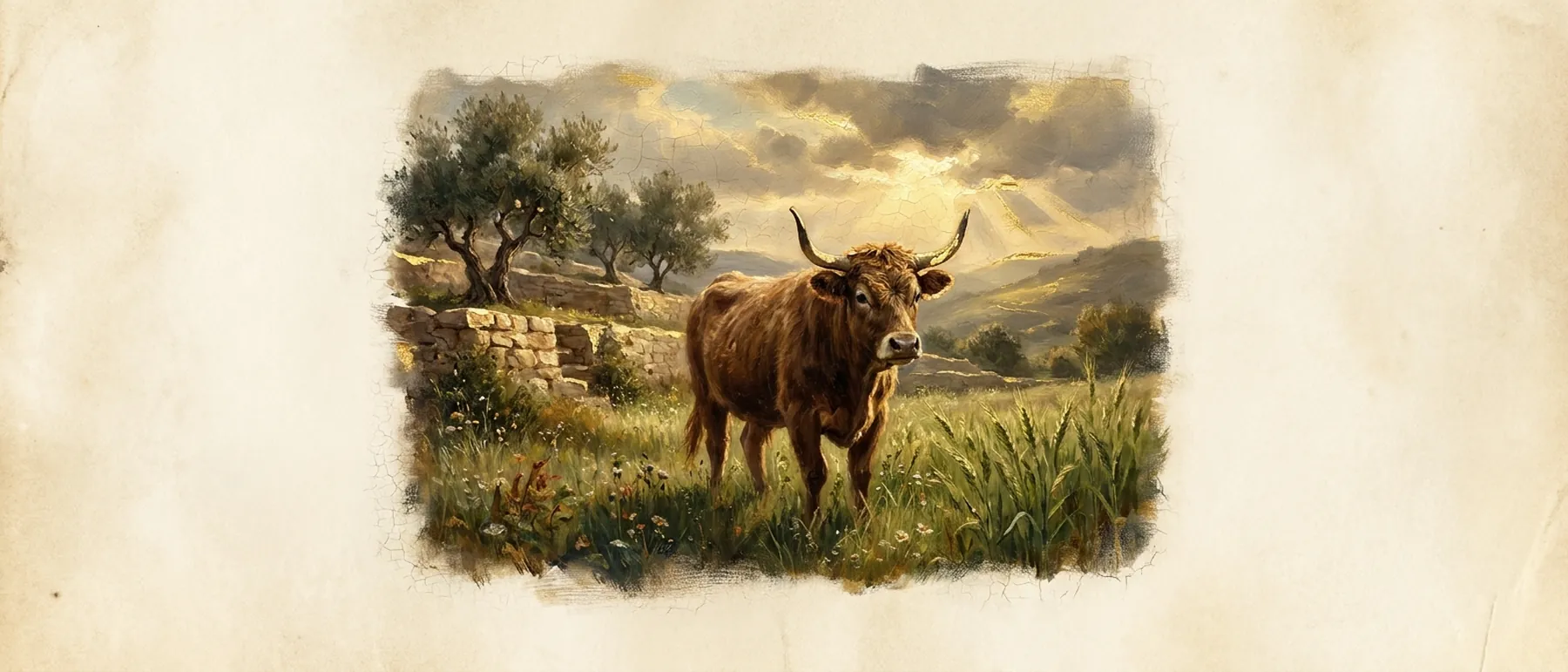
The Tribe of Ephraim — the younger son, the ox, and the month of Tishrei
The tribe of Ephraim descends from Ephraim, the younger son of Joseph and Asenath, whom Jacob counted as his own son; Joseph named him for "God has made me fertile in the land of my affliction." The Midrash puts an ox on Ephraim's banner, and the banner tradition pairs Ephraim with Tishrei.
The name and the birth
Ephraim was not one of Jacob's twelve sons. He was Jacob's grandson, born in Egypt to Joseph and Asenath daughter of Poti-phera "before the years of famine came." Joseph named the first-born Manasseh and the second Ephraim, "meaning, 'God has made me fertile in the land of my affliction.'"
The Hebrew is ki hifrani Elohim, כִּי־הִפְרַנִי אֱלֹהִים. Hifrani, "has made me fertile," and Ephraim, אֶפְרַיִם, share the letters פ־ר. The JPS translation notes the link: hiphrani, "connected with 'Ephraim.'"
Ephraim became a tribe because Jacob adopted Joseph's sons. Before he died Jacob told Joseph: "Ephraim and Manasseh shall be mine no less than Reuben and Simeon." That is why Joseph's line counts as two tribes, and why Ephraim and Manasseh each have a page here while Joseph has his own.
Jacob's blessing (Genesis 48–49)
Ephraim's real blessing comes in Genesis 48. Joseph set Manasseh, the first-born, at Jacob's right hand. Jacob crossed his arms and put his right hand on Ephraim, "though he was the younger." When Joseph objected, Jacob answered: "I know, my son, I know. He too shall become a people, and he too shall be great. Yet his younger brother shall be greater than he."
In Genesis 49, Jacob blesses Joseph rather than Ephraim by name. Its opening phrase, ben porat Yosef, is hard to translate: the 1917 JPS reads "Joseph is a fruitful vine," while the newer JPS reads "Joseph is a wild ass."
Moses' blessing (Deuteronomy 33)
Moses also blesses Joseph as a whole and then names both sons in the last line:
Ephraim gets the larger number, "myriads," against Manasseh's "thousands." The firstling bull is where the Midrash finds Ephraim's emblem.
Symbol, flag and stone
The symbol of the tribe of Ephraim is an ox. Bamidbar Rabbah 2:7 says Joseph's banner was "exceedingly black" and showed Egypt for both chieftains, Ephraim and Manasseh, "because they were born in Egypt." Then: "On the banner of Ephraim an ox was depicted, based on: 'The firstborn of his bull [is his majesty]' (Deuteronomy 33:17); this is Joshua bin Nun, who was from the tribe of Ephraim." Manasseh's banner showed a wild ox (re'em).
Ephraim has no stone of its own. Exodus 28:21 says the twelve stones correspond "to the names of the sons of Israel," and Joseph, not Ephraim, was Jacob's son. The stone associated with Ephraim is therefore Joseph's:
| Source | Joseph's stone (Hebrew) | How it is translated |
|---|---|---|
| Bamidbar Rabbah 2:7 | shoham שֹׁהַם | onyx |
| Exodus 28:20, JPS | shoham שֹׁהַם | lapis lazuli |
| Rashi on Exodus 28:21 (birth order) | the eleventh stone, shoham | — |
Rashi says the stones follow the order of the sons' births. Joseph was the eleventh son, and the eleventh stone in the list is shoham, so here Rashi's order and the Midrash agree. What shoham actually was is unknown; the two translations above disagree.
In the wilderness and in the land
| Tribe of Ephraim | |
|---|---|
| First census (Numbers 1:33) | 40,500 |
| Second census (Numbers 26:37) | 32,500 |
| Camp | West side; Ephraim led its own division with Manasseh and Benjamin, 108,100 in all, marching third |
| Chieftain | Elishama son of Ammihud; brought his offering on the seventh day |
| Territory | From Atroth-addar to Upper Beth-horon and on to the Sea; the line touched Jericho and ran to the Jordan (Joshua 16:5–10) |
| Notable figures | Joshua son of Nun; Jeroboam son of Nebat |
Joshua. Among the twelve scouts Moses sent, Ephraim's was "Hosea son of Nun," whom Moses renamed Joshua. After the conquest he received the town he asked for, Timnath-serah "in the hill country of Ephraim," and he was buried there at the age of 110.
Jeroboam and the northern kingdom. After Solomon, the kingdom split. Jeroboam son of Nebat, "an Ephraimite of Zeredah," was made king "over all Israel," and "only the tribe of Judah remained loyal to the House of David." He fortified Shechem "in the hill country of Ephraim" and lived there.
Ephraim in the prophets. Hosea, who prophesied in the reign of Jeroboam son of Joash, king of Israel, uses "Ephraim" as a name for that kingdom in more than thirty verses, from chapter 4 to chapter 14. In Hosea 11:8 the two names stand side by side: "How can I give you up, O Ephraim? How surrender you, O Israel?"
The tribe and the Hebrew month
A later tradition pairs each Hebrew month with a tribe, following the order in which the tribes marched in Numbers 10:14–27. Rabbi Tzvi Elimelech of Dinov writes in Bnei Yissaschar that the month of Tishrei, "according to the order of the banners, is attributed to Ephraim, who is seventh in the journeying of the banners."
He then adds a detail from Judges 12. When the men of Gilead held the fords of the Jordan against Ephraim, they tested fugitives by asking them to say shibboleth; an Ephraimite "would say sibboleth, not being able to pronounce it correctly." Bnei Yissaschar reads this inability to say the right-hand shin as fitting Tishrei, the month of Rosh Hashanah and judgment.
On this site Tishrei's sign is Moznayim (Libra); see the Libra page and the Jewish zodiac signs. The pairing is interpretation, a way of reading the months, and says nothing about anyone's ancestry.
Frequently asked questions
What is the symbol of the tribe of Ephraim?
An ox. Bamidbar Rabbah 2:7 says Ephraim's banner showed an ox, based on Moses' words "like a firstling bull in his majesty" (Deuteronomy 33:17), and connects it to Joshua, who was from Ephraim. The same midrash says Joseph's black banner showed Egypt for both Ephraim and Manasseh.
What does the name Ephraim mean?
Joseph named his second son Ephraim, saying "God has made me fertile in the land of my affliction" (Genesis 41:52). The Hebrew verb hifrani, "has made me fertile," shares its root letters with the name. The verse ties the name to Joseph's years in Egypt.
Was Ephraim one of the twelve sons of Jacob?
No. Ephraim was Joseph's younger son, Jacob's grandson. Jacob adopted him and his brother: "Ephraim and Manasseh shall be mine no less than Reuben and Simeon" (Genesis 48:5). As a result Joseph's descendants count as two tribes, Ephraim and Manasseh.
Why did Jacob bless Ephraim before Manasseh?
In Genesis 48 Jacob crossed his hands and put his right hand on Ephraim, the younger. When Joseph objected, Jacob said Manasseh would also be great, "yet his younger brother shall be greater than he." The chapter ends: "Thus he put Ephraim before Manasseh" (Genesis 48:20).
Why is the northern kingdom called Ephraim?
Jeroboam, the first king of the breakaway kingdom of Israel, was an Ephraimite and ruled from Shechem in the hill country of Ephraim (1 Kings 11:26; 12:25). The prophet Hosea often calls that kingdom "Ephraim," setting the name in parallel with "Israel" (Hosea 11:8).
What month is the tribe of Ephraim?
Tishrei. Bnei Yissaschar says Tishrei is attributed to Ephraim because Ephraim's banner was seventh to set out in Numbers 10, and Tishrei is the seventh month from Nisan. This is a later interpretive tradition, not a statement of the Torah.
Ephraim is one of the twelve tribes of Israel, counted with Manasseh in place of Joseph. If you want to see which month and tribe your own Hebrew birthday falls under, the free Jewish zodiac reading starts from your Hebrew birth date.
In the sources
Every text below was read in the linked edition while this page was written.
- Genesis.41.50-52 — sefaria.org
- Genesis.41.52 — sefaria.org
- Genesis.48.5 — sefaria.org
- Genesis.48.13-20 — sefaria.org
- Genesis.49.22 — sefaria.org
- Deuteronomy.33.17 — sefaria.org
- Bamidbar Rabbah.2.7 — sefaria.org
- Exodus.28.17-21 — sefaria.org
- Rashi on Exodus.28.21 — sefaria.org
- Genesis.29.32-30.24 — sefaria.org
- Numbers.1.32-33 — sefaria.org
- Numbers.26.35-37 — sefaria.org
- Numbers.2.18-24 — sefaria.org
- Numbers.7.48 — sefaria.org
- Joshua.16.4-10 — sefaria.org
- Numbers.13.8-16 — sefaria.org
- Bnei Yissaschar, Tishrei.1.1 — sefaria.org
- Joshua.24.29-30 — sefaria.org
- I Kings.11.26 — sefaria.org
- I Kings.12.20-25 — sefaria.org
- Hosea.1.1 — sefaria.org
- Hosea.11.8 — sefaria.org
- Numbers.10.14-27 — sefaria.org
- Judges.12.5-6 — sefaria.org
- Hosea.4-14 — sefaria.org
Names, mothers, emblems, stones and months in one table.
Name, blessings, emblem and month.
Name, blessings, emblem and month.