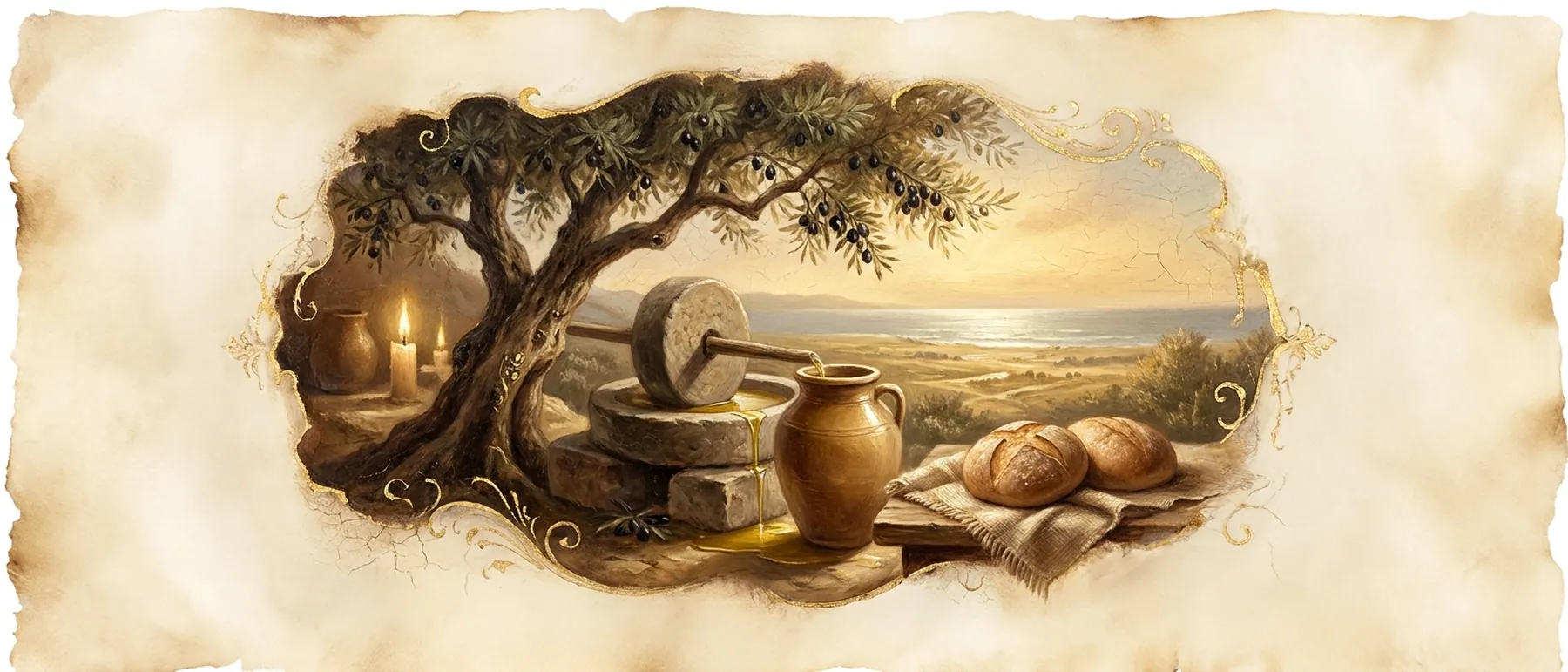
The Tribe of Asher — the olive tree, the seacoast, and the month of Shevat
The tribe of Asher descends from Asher, Jacob's son by Zilpah, Leah's maid; Leah named him saying women "will deem me fortunate," so the name means happy or fortunate (Genesis 30:13). In the Midrash its banner shows an olive tree. Its land ran along the northern coast. In the banner tradition its month is Shevat.
The Hebrew name is Asher. Both of the Torah's blessings for the tribe speak of richness, and later sources link it with olive oil.
The name and the birth
Asher was the second son that Zilpah, Leah's maid, bore to Jacob. Leah named him: "Leah declared, 'What fortune!' meaning, 'Women will deem me fortunate.' So she named him Asher." The JPS note connects the Hebrew be-oshri with the name Asher.
Asher's brother by the same mother was Gad, and the two are listed together among "the descendants of Zilpah, whom Laban had given to his daughter Leah."
Jacob's blessing (Genesis 49)
Jacob's words for Asher are one verse: "Asher's bread shall be rich, and he shall yield royal dainties." The Hebrew shemenah lachmo uses the word for fat or oil, shemen. In plain terms, Asher's land will produce fine food, good enough for a king's table.
Moses' blessing (Deuteronomy 33)
Moses' blessing returns to oil: "Most blessed of sons be Asher; may he be the favorite of his brothers, may he dip his foot in oil." The next line, "May your doorbolts be iron and copper, and your security last all your days," is marked by the translators as uncertain in meaning.
The Talmud reads the oil literally. Menachot 85b says "dip his foot in oil" refers to "the portion of Asher, as the oil flows there like a spring." It tells of a messenger from Laodicea who searched Jerusalem and Tyre for a huge quantity of oil and found it only at Gush Halav, "located in the portion of Asher."
Symbol, flag and stone
The Torah does not describe tribal flags. The Midrash Bamidbar Rabbah 2:7 says each prince's banner was the color of his tribe's stone on the high priest's breastplate. For Asher: "its stone was a beryl, and the color of its banner was like the gem with which women adorn themselves, and an olive tree was depicted on it," based on "Asher's bread is rich" (Genesis 49:20). The translator's note explains the link: the olive tree produces olive oil, shemen.
So the symbol of the tribe of Asher, in this Midrash, is the olive tree.
The stone is the tarshish, the first stone of the fourth row, tenth of the twelve. The JPS Tanakh also translates it "beryl." JPS notes that "the identity of several of the following twelve stones is uncertain." Rashi on Exodus 28:21 says the stones followed the order of the brothers' births, but he names only Reuben's and Simeon's stones. The assignment of the tarshish to Asher comes from the Midrash, not from the Torah or Rashi, so treat it as one tradition among several attempts to match stones to tribes.
In the wilderness and in the land
| Tribe of Asher | |
|---|---|
| First census (Numbers 1:41) | 41,500 |
| Second census (Numbers 26:47) | 53,400 |
| Camp (Numbers 2:25–28) | North, in Dan's division with Dan and Naphtali; that division marched last |
| Chieftain (Numbers 1:13, 7:72) | Pagiel son of Ochran, who brought his offering on the eleventh day |
| Territory (Joshua 19:24–31) | Fifth lot: the coast from Carmel north toward Tyre and "Great Sidon," 22 towns |
Asher's land faced the sea. In the Song of Deborah, Asher is named among the tribes that stayed where they were: "Asher remained at the seacoast and tarried at his landings" (Judges 5:17).
The tribe's best-known member is a woman. Genesis 46:17 lists "Asher's sons: Imnah, Ishvah, Ishvi, and Beriah, and their sister Serah." Serah (Hebrew Serach) is the only granddaughter of Jacob named in the list of the seventy who went down to Egypt. She is named again in the second census, taken on the steppes of Moab: "The name of Asher's daughter was Serah" (Numbers 26:46). Many later legends grew up around her. This page stays with what the verses say.
The tribe and the Hebrew month
The pairing of tribes with Hebrew months is later tradition. Bnei Yissaschar, by R. Tzvi Elimelech of Dinov, follows the order in which the tribes marched under their banners in Numbers 10:14–27. Asher is eleventh, between Dan and Naphtali, under Pagiel son of Ochran. The eleventh month counted from Nisan is Shevat.
Bnei Yissaschar writes: "This month, according to the order of the banners, relates to the Tribe of Asher." It quotes "Asher's bread will be rich" and "May he dip his foot in oil," says there was much olive oil in Asher's portion, and adds that where olive oil is found, wisdom is found.
So the tribe of Asher goes with the month of Shevat, whose sign is Dli, the bucket or water-carrier, matching Aquarius. Its banner-neighbors are Dan, paired with Tevet, and Naphtali, paired with Adar.
This is a reading of the calendar, not a claim about anyone's ancestry. For all twelve signs, see the Jewish zodiac signs.
Frequently asked questions
What does the name Asher mean?
Happy or fortunate. At his birth Leah exclaimed be-oshri, which the JPS translation renders "What fortune," explained as "Women will deem me fortunate," and named him Asher (Genesis 30:13). The meaning comes from the naming verse itself.
What is the symbol of the tribe of Asher?
According to the Midrash Bamidbar Rabbah 2:7, Asher's banner showed an olive tree, based on Jacob's blessing "Asher's bread shall be rich" (Genesis 49:20), because the olive produces oil. The banner's color matched its breastplate stone, which the Midrash translation calls beryl.
Why is the tribe of Asher linked with olive oil?
Moses blessed Asher, "may he dip his foot in oil" (Deuteronomy 33:24). The Talmud in Menachot 85b reads this as describing Asher's land, where "the oil flows there like a spring," and tells a story of a buyer who found a vast supply of oil at Gush Halav in Asher's portion. The Midrash puts an olive tree on Asher's banner.
Who was Serah, daughter of Asher?
Serah (Serach) is named in Genesis 46:17 as the sister of Asher's sons and appears again in the census of Numbers 26:46. She is the only granddaughter of Jacob named in the list of seventy who went down to Egypt. Later Jewish tradition tells many stories about her, but the Torah itself gives only her name.
Who was Asher's mother?
Zilpah, the maid whom Laban gave to Leah. Genesis 30:12–13 says Zilpah bore Jacob "a second son" and that Leah named him Asher. Genesis 46 lists Zilpah's descendants as the families of Gad and Asher, so Gad was his full brother.
What month is the tribe of Asher?
Shevat. Bnei Yissaschar follows the marching order of Numbers 10, where Asher is eleventh, and links the month to Asher's olive oil and to wisdom. The pairing is later tradition, not a statement about anyone's descent.
Read how Asher fits among the other tribes in the twelve tribes of Israel. If you want to see which month and tribe your own Hebrew birth date falls under, try the free Jewish zodiac reading.
In the sources
Every text below was read in the linked edition while this page was written.
- Genesis 30:12-13 — sefaria.org
- Genesis 49:20 — sefaria.org
- Deuteronomy 33:24-25 — sefaria.org
- Bamidbar Rabbah 2:7 — sefaria.org
- Exodus 28:20 (parallel 39:13) — sefaria.org
- Rashi on Exodus 28:21:1 — sefaria.org
- Numbers 1:13; 1:40-41 — sefaria.org
- Numbers 26:3; 26:44-47 — sefaria.org
- Numbers 2:25-31 — sefaria.org
- Numbers 7:72 — sefaria.org
- Joshua 19:24-31 — sefaria.org
- Judges 5:17 — sefaria.org
- Genesis 46:17-18 (list 46:8-27) — sefaria.org
- Menachot 85b:14-15 — sefaria.org
- Numbers 10:14-27 (v.26) — sefaria.org
- Bnei Yissaschar, Shevat 1:8 (segment 1) — sefaria.org
Names, mothers, emblems, stones and months in one table.
Name, blessings, emblem and month.
Name, blessings, emblem and month.