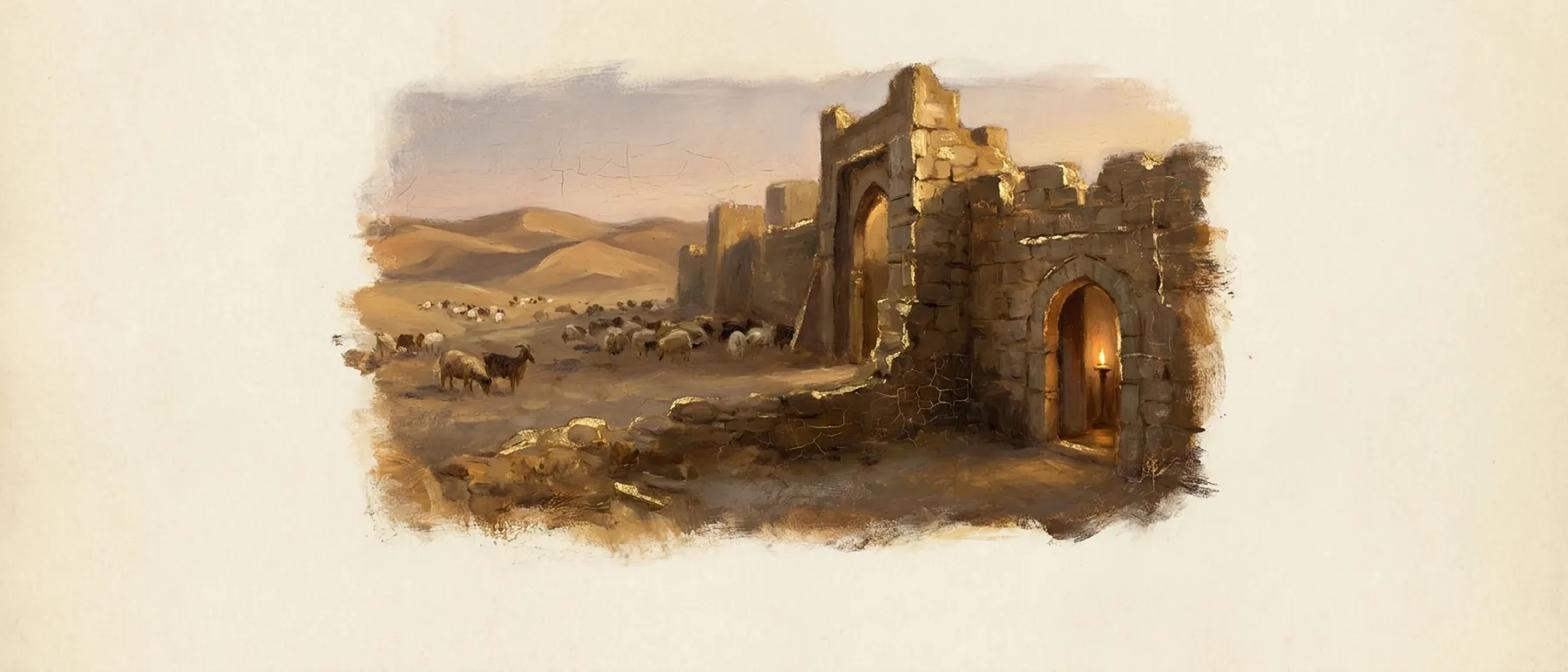
The Tribe of Simeon — the scattered tribe and the month of Av
The tribe of Simeon descends from Simeon, Leah's second son by Jacob; she named him because "God heard" (shama) that she was unloved. Jacob's blessing says "scatter them in Israel," Moses' blessing leaves Simeon out, the Midrash gives it a green banner, and tradition pairs it with Av.
Simeon (Hebrew Shimon) is the tribe whose land sat inside another tribe's. The Book of Joshua says Simeon's portion "lay inside the portion of the Judahites."
The name and the birth
Genesis 29 tells how Leah, who was unloved, bore Jacob's first sons. Her first was Reuben. Then: "She conceived again and bore a son, and declared, 'This is because GOD heard that I was unloved and has given me this one also'; so she named him Simeon" (Genesis 29:33, JPS translation on Sefaria).
The word play is on shama (שָׁמַע), "heard," and the name Shimon (שִׁמְעוֹן). The JPS note says so directly: "Heb. shamaʻ, connected with 'Simeon.'" Genesis 35:23 lists the sons of Leah in order: Reuben, Simeon, Levi, Judah, Issachar and Zebulun.
Jacob's blessing (Genesis 49)
Simeon does not get a blessing of his own in Genesis 49. Jacob speaks to him together with Levi, and the words look back to Genesis 34.
In Genesis 34, after their sister Dinah "had been defiled," "Simeon and Levi, two of Jacob's sons, brothers of Dinah, took each his sword, came upon the city unmolested, and slew all the males." They killed Hamor and his son Shechem and took Dinah out of Shechem's house. Jacob told them, "You have brought trouble on me," and they answered, "Should our sister be treated like a whore?"
Genesis 49:5–7 is Jacob's last word on it:
"Simeon and Levi are a pair; their weapons are tools of lawlessness. Let not my person be included in their council, let not my being be counted in their assembly. For when angry they slay a man, and when pleased they maim an ox. Cursed be their anger so fierce, and their wrath so relentless. I will divide them in Jacob, scatter them in Israel" (JPS).
The Hebrew of the last line is achalkem be-Yaakov va-afitzem be-Yisrael (אֲחַלְּקֵם בְּיַעֲקֹב וַאֲפִיצֵם בְּיִשְׂרָאֵל). The JPS notes flag uncertainty in the middle verse: "a man" may mean "a rival" or "men," and "maim an ox" may mean "overthrow a dignitary."
Rashi makes two points. First, Jacob cursed their anger, not the brothers themselves. Second, he gives two readings of "I will divide them": Levi would not be counted among the tribes, so the pair is split; or both tribes would be dispersed, Simeon through poor scribes and teachers of children who moved from town to town, and Levi through collecting tithes "in a more respectable manner." The English edition of Rashi on Sefaria traces these readings to Genesis Rabbah.
Moses' blessing (Deuteronomy 33)
Simeon is absent from Moses' blessing. Deuteronomy 33 blesses Reuben, Judah, Levi, Benjamin, Joseph (with Ephraim and Manasseh named inside his blessing), Zebulun with Issachar, Gad, Dan, Naphtali and Asher. There is no verse for Simeon.
The chapter itself gives no reason. It is natural to connect the omission with Jacob's words in Genesis 49, but that is interpretation; Deuteronomy 33 is silent on why Simeon is missing. Levi, condemned alongside Simeon in Genesis 49, does receive a blessing (Deuteronomy 33:8–11).
Symbol, flag and stone
The Torah does not describe the tribal banners. Bamidbar Rabbah 2:7 does: each prince's banner was the color of his tribe's stone on the High Priest's breastplate.
For Simeon it gives:
- Stone: pitdah (פִּטְדָה)
- Banner color: green
- Emblem: Shechem (the Sefaria translation spells it "Shekhem")
For most tribes the midrash quotes a verse to explain the picture, such as Genesis 49:21 for Naphtali's hind. For Simeon it gives none, so any link to the Shechem story of Genesis 34 is the reader's inference, not the midrash's stated reason.
Rashi's rule is that the stones followed the brothers' birth order. Simeon was the second son, and pitdah is the second stone.
In the wilderness and in the land
| Simeon | Source | |
|---|---|---|
| First census (men 20 and over able to bear arms) | 59,300 | Numbers 1:22–23 |
| Second census | 22,200 | Numbers 26:12–14 |
| Camp side | South, in the division of Reuben, with Reuben and Gad | Numbers 2:10–16 |
| Marching order | Second division to set out; Simeon is its second troop | Numbers 2:16; 10:18–19 |
| Prince (chieftain) | Shelumiel son of Zurishaddai | Numbers 1:6; 2:12 |
| Day of the Tabernacle offering | Fifth day | Numbers 7:36 |
| Territory | The second lot, inside Judah's portion: Beer-sheba, Hormah, Ziklag and other towns | Joshua 19:1–9 |
The second count is less than half the first, and the census verses themselves do not explain the drop. Numbers 26:12–14 names five Simeonite clans: the Nemuelites, Jaminites, Jachinites, Zerahites and Saulites.
Land inside Judah. Joshua 19:9 gives the reason in plain terms: "since the share of the Judahites was larger than they needed, the Simeonites received a portion inside their portion." The towns listed in Joshua 19:2–7 include Beer-sheba, Moladah, Hormah and Ziklag. One can read this as Jacob's "divide them in Jacob" played out on the map, but the Book of Joshua itself gives only the practical reason.
Fighting beside Judah. Judges 1:3 has Judah invite "their brother-tribe Simeon" to fight the Canaanites together in each other's territory, "So Simeon joined them."
Zimri. Numbers 25:14 names "Zimri son of Salu, chieftain of a Simeonite ancestral house," as the Israelite man killed with the Midianite woman.
The tribe and the Hebrew month
A later Jewish tradition pairs the twelve Hebrew months with the twelve tribes by the order in which the tribal banners set out in Numbers 10:14–27. Bnei Yissaschar, a Hasidic work arranged by the months of the year, states the principle at the start of its Tishrei section: Tishrei "according to the order of the banners" is ascribed to Ephraim, seventh in the march.
The first division is Judah, Issachar and Zebulun; the second is Reuben, Simeon and Gad. Simeon is the fifth troop, so it falls on the fifth month counting from Nisan, the month of Av. Sefer Yetzirah 5:2 pairs Av with Aryeh, the lion (Leo).
Levi, Simeon's partner in Genesis 34 and 49, has no month in this scheme: in Numbers 10:17 and 10:21 the Levite clans (Gershonites, Merarites and Kohathites) march between the divisions carrying the Tabernacle, not as one of the twelve banner troops. The pairing is interpretation, not a statement of the Torah, and says nothing about anyone's actual ancestry. Sefer Yetzirah names no tribes. For the twelve signs, see the Jewish zodiac signs.
Frequently asked questions
What does the name Simeon mean?
Genesis 29:33 explains it. Leah said, "This is because GOD heard that I was unloved and has given me this one also," and named the child Simeon. The Hebrew name Shimon is built on shama, "heard," and the JPS note on the verse makes that connection explicitly. The name records Leah's situation, not a trait of the child.
Why is Simeon not in Moses' blessing?
Deuteronomy 33 blesses every other tribe of Jacob's sons but has no verse for Simeon, and the chapter does not say why. It is natural to connect the omission with Genesis 49:5–7, where Jacob condemns the anger of Simeon and Levi after Shechem, but that link is interpretation. Levi, the other brother in that story, does receive a blessing in Deuteronomy 33:8–11.
What is the symbol of the tribe of Simeon?
Bamidbar Rabbah 2:7 says Simeon's banner was green and that Shechem was depicted on it. Unlike most tribes in that passage, it gives no verse to explain the picture. The Torah itself does not describe the tribal flags; this description comes from the Midrash.
What stone represents Simeon?
The pitdah, the second stone of the first row of the High Priest's breastplate (Exodus 28:17). Both Bamidbar Rabbah 2:7 and Rashi on Exodus 28:21 assign it to Simeon. Translations disagree about the gem: peridot, chrysolite and topaz all appear, and Klein's dictionary calls it probably topaz.
Where did the tribe of Simeon live?
Inside the territory of Judah. Joshua 19:1 says Simeon's portion "lay inside the portion of the Judahites," and Joshua 19:9 explains that Judah's share was larger than it needed. The towns named include Beer-sheba, Moladah, Hormah and Ziklag, 13 towns in one list and 4 more in another, with their villages.
What month is the tribe of Simeon?
Av, in the tradition that pairs months with tribes by the order of the banners in Numbers 10:14–27. Simeon is the fifth troop named there, and Av is the fifth month counting from Nisan. The pairing is later interpretation, found in works such as Bnei Yissaschar, not a statement of the Torah.
Simeon is one of the twelve tribes of Israel. To see which Hebrew month, sign and tribe tradition pairs with your own birthday, the free Jewish zodiac reading works it out from your Hebrew birth date, and the Hebrew birthday calculator finds the date itself.
In the sources
Every text below was read in the linked edition while this page was written.
- Genesis 29:33 — sefaria.org
- Genesis 35:23 — sefaria.org
- Genesis 34:25-31 — sefaria.org
- Genesis 49:5-7 — sefaria.org
- Rashi on Genesis 49:7:1-2 — sefaria.org
- Deuteronomy 33:1-29 — sefaria.org
- Bamidbar Rabbah 2:7 — sefaria.org
- Exodus 28:17-21 — sefaria.org
- Exodus 39:10-14 — sefaria.org
- Rashi on Exodus 28:21:1 — sefaria.org
- Klein Dictionary, s.v. פִּטְדָה — sefaria.org
- Numbers 1:22-23 — sefaria.org
- Numbers 26:12-14 — sefaria.org
- Numbers 2:10-16 — sefaria.org
- Numbers 1:6 — sefaria.org
- Numbers 7:36 — sefaria.org
- Joshua 19:1-9 — sefaria.org
- Judges 1:3 — sefaria.org
- Numbers 25:14 — sefaria.org
- Numbers 10:14-27 — sefaria.org
- Bnei Yissaschar, Tishrei 1:1 — sefaria.org
- Sefer Yetzirah 5:2 — sefaria.org
- Genesis 29:31-32 — sefaria.org
Names, mothers, emblems, stones and months in one table.
Name, blessings, emblem and month.
Name, blessings, emblem and month.