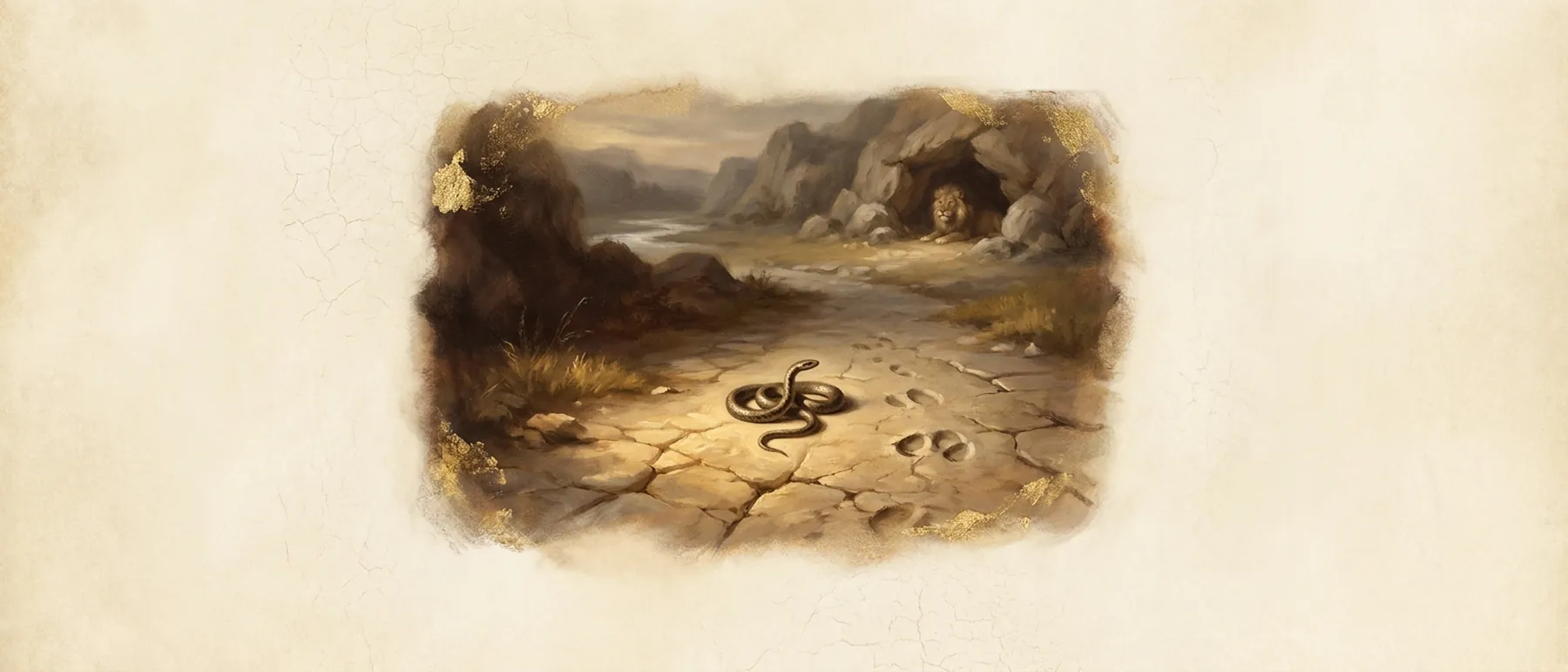
The Tribe of Dan — the serpent, the judge, and the month of Tevet
The tribe of Dan descends from Dan, Jacob's son by Bilhah, Rachel's maid; Rachel named him for the words "God has vindicated me." The Midrash puts a serpent on Dan's banner, after Jacob's blessing. In the tradition that pairs tribes with Hebrew months, Dan's month is Tevet.
The name and the birth
Rachel had no children and gave Jacob her maid Bilhah, so that "through her I too may have children." When Bilhah bore a son, Rachel said, "God has vindicated me; indeed, [God] has heeded my plea and given me a son. Therefore she named him Dan."
The Hebrew is dananni Elohim, דָּנַנִּי אֱלֹהִים. The root, דין, means to judge or to plead someone's cause (Klein's dictionary), and the name Dan, דָּן, is built from the same letters. The JPS translation notes the link directly: dananni, "connected with 'Dan.'"
Dan was Jacob's fifth son. Leah had borne Reuben, Simeon, Levi and Judah before him, and Bilhah's second son, Naphtali, was born next. That makes the tribe of Naphtali Dan's full brother tribe, through the same mother.
Jacob's blessing (Genesis 49)
Jacob's words to Dan play on the name a second time:
In Hebrew the first line is Dan yadin amo, דָּן יָדִין עַמּוֹ: "Dan will judge his people." Rashi reads it as Dan taking vengeance for his people against the Philistines, and says the prophecy alludes to Samson. On the serpent that brings down a rider without touching him, Rashi points to Samson pulling down the pillars of the Philistine temple, where those on the roof died without being struck.
Moses' blessing (Deuteronomy 33)
Moses gives Dan one line: "Dan is a lion's whelp that leaps forth from Bashan." So the Torah gives Dan two animal images, a serpent from Jacob and a young lion from Moses. The Midrash chose the serpent for the banner.
Symbol, flag and stone
The symbol of the tribe of Dan is a serpent. Bamidbar Rabbah 2:7 describes each tribe's banner as matching the color of its stone on the high priest's breastplate. For Dan it says: "Dan, [its stone was] a jacinth, the color of its banner was like a sapphire, and a serpent was depicted on it, based on: 'Dan will be a serpent' (Genesis 49:17)."
The breastplate itself is described in Exodus 28:17–21: four rows of three stones, "corresponding to the names of the sons of Israel: twelve." Which stone was Dan's depends on whom you read:
| Source | Dan's stone (Hebrew) | How it is translated |
|---|---|---|
| Bamidbar Rabbah 2:7 | leshem לֶשֶׁם | jacinth |
| Rashi on Exodus 28:21 (stones follow birth order) | the fifth stone, sapir סַפִּיר | sapphire |
Rashi says the stones follow the order of the sons' births: "a sardius for Reuben, a topaz for Simeon, and so in the case of all of them." Dan was the fifth son, so on Rashi's reading his stone is the fifth one listed, sapir. The Midrash gives Dan leshem but colors his banner like sapir.
Nobody knows for certain which modern gems the Hebrew names refer to. The JPS translation and the Sefaria translation of the Midrash render several of the same Hebrew words differently (for example, yahalom is "amethyst" in one and "clear quartz" in the other). Treat any English gem name as a guess.
In the wilderness and in the land
| Tribe of Dan | |
|---|---|
| First census (Numbers 1:39) | 62,700 |
| Second census (Numbers 26:43) | 64,400 |
| Camp | North side; Dan led its own division with Asher and Naphtali, 157,600 in all, marching last |
| Chieftain | Ahiezer son of Ammishaddai; brought his offering on the tenth day |
| Territory | Seventh lot: Zorah, Eshtaol, Aijalon, Timnah, Ekron, Bene-berak and towns near Joppa (Joshua 19:40–46) |
| Notable figure | Samson (Judges 13–16) |
When the camp set out, Dan's standard came last, "as the rear guard of all the divisions."
Samson. Judges 13 opens with "a certain man from Zorah, of the stock of Dan, whose name was Manoah." An angel told his wife she would bear a son who would be a nazirite from the womb and "the first to deliver Israel from the Philistines." The spirit of God first moved Samson "in the encampment of Dan, between Zorah and Eshtaol." He died bringing down the Philistine temple and was buried "between Zorah and Eshtaol" in his father's tomb, after leading Israel for twenty years.
The migration to Laish. The tribe did not hold its first allotment. Judges says the Amorites "pressed the Danites into the hill country; they would not let them come down to the plain." Joshua 19:47 says the territory "slipped from their grasp," so the Danites took a town called Leshem and renamed it Dan. Judges 18 tells the longer story: the tribe sent five scouts from Zorah and Eshtaol, then captured Laish, "a people tranquil and unsuspecting," rebuilt it and "named the town Dan, after their ancestor Dan." The two books name the old town differently (Leshem in Joshua, Laish in Judges). A few chapters later, Judges 20:1 gathers "all the Israelites—from Dan to Beer-sheba," using the new town's name to mark one end of the land.
Judges 18 also records that the Danites set up the carved image they had taken from Micah's house. The Bible does not present this migration as a heroic chapter.
The tribe and the Hebrew month
A later tradition pairs each Hebrew month with a tribe, following the order in which the tribes marched in Numbers 10:14–27. Rabbi Tzvi Elimelech of Dinov states the principle in Bnei Yissaschar: Tishrei is assigned to Ephraim "according to the order of the banners," since Ephraim was seventh to set out. Dan marched tenth, so Dan is paired with the tenth month counted from Nisan: the month of Tevet. On this site that month's sign is Gedi (Capricorn); see the Capricorn page and the Jewish zodiac signs.
This pairing is interpretation, a way of reading the months. It says nothing about anyone's ancestry.
Frequently asked questions
What is the symbol of the tribe of Dan?
A serpent. Bamidbar Rabbah 2:7 says Dan's banner showed a serpent, based on Jacob's blessing "Dan shall be a serpent by the road" (Genesis 49:17). The same midrash says the banner's color was like sapphire. Moses' blessing compares Dan to a lion's whelp (Deuteronomy 33:22), but the midrash took the serpent for the flag.
What does the name Dan mean?
Rachel named him when Bilhah bore him, saying dananni Elohim, "God has vindicated me" (Genesis 30:6). The root means to judge or to argue a case. Jacob repeats the play in his blessing: Dan yadin amo, "Dan shall govern (or judge) his people" (Genesis 49:16).
Was Samson from the tribe of Dan?
Yes. Judges 13:2 calls his father Manoah "a certain man from Zorah, of the stock of Dan." Samson's story runs through Judges 13–16. Rashi reads Jacob's blessing of Dan, including the serpent that throws the rider backward, as a prophecy about Samson.
What stone represents the tribe of Dan?
Sources differ. Bamidbar Rabbah 2:7 gives Dan the leshem, usually translated jacinth. Rashi on Exodus 28:21 says the stones follow birth order; Dan was the fifth son, which gives him the fifth stone, sapir, translated sapphire. The ancient stones cannot be identified with certainty, and English names vary between translations.
Where did the tribe of Dan live?
Its first allotment included Zorah, Eshtaol, Ekron and Bene-berak, reaching the border near Joppa (Joshua 19:40–46). The tribe could not hold the plain and migrated, capturing Laish (also called Leshem) and renaming it Dan (Joshua 19:47; Judges 18).
What month is the tribe of Dan?
Tevet. The tradition recorded in Bnei Yissaschar matches the months, from Nisan, to the order in which the tribes marched in Numbers 10. Dan's standard set out tenth, and Tevet is the tenth month from Nisan. This is a later interpretive tradition, not a biblical statement.
Dan is one of the twelve tribes of Israel; its neighbors on the march were Asher and Naphtali. If you were born in Tevet, or want to know which month and tribe your own Hebrew birthday falls under, the free Jewish zodiac reading starts from your Hebrew birth date.
In the sources
Every text below was read in the linked edition while this page was written.
- Genesis.30.3-6 — sefaria.org
- Genesis.30.6 — sefaria.org
- Genesis.29.32-30.8 — sefaria.org
- Genesis.49.16-18 — sefaria.org
- Rashi on Genesis.49.16 — sefaria.org
- Rashi on Genesis.49.17 — sefaria.org
- Deuteronomy.33.22 — sefaria.org
- Klein Dictionary, דין — sefaria.org
- Bamidbar Rabbah.2.7 — sefaria.org
- Exodus.28.17-21 — sefaria.org
- Rashi on Exodus.28.21 — sefaria.org
- Numbers.1.38-39 — sefaria.org
- Numbers.26.42-43 — sefaria.org
- Numbers.2.25-31 — sefaria.org
- Numbers.7.66 — sefaria.org
- Joshua.19.40-48 — sefaria.org
- Judges.13.2-25 — sefaria.org
- Judges.16.28-31 — sefaria.org
- Bnei Yissaschar, Tishrei.1.1 — sefaria.org
- Numbers.10.14-27 — sefaria.org
- Numbers.10.25 — sefaria.org
- Judges.1.34 — sefaria.org
- Judges.18.1-2 — sefaria.org
- Judges.18.27-31 — sefaria.org
- Judges.20.1 — sefaria.org
Names, mothers, emblems, stones and months in one table.
Name, blessings, emblem and month.
Name, blessings, emblem and month.