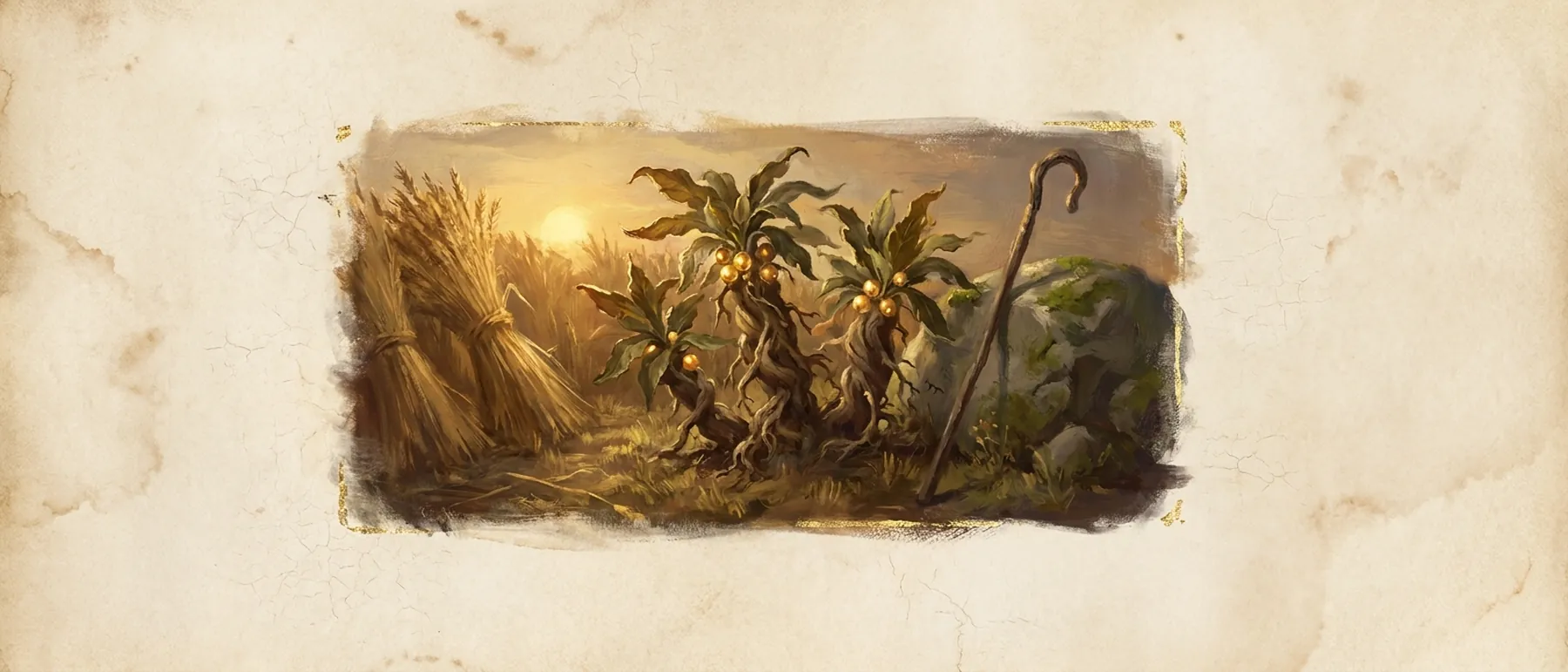
The Tribe of Reuben — the first-born, east of the Jordan, and the month of Tammuz
The tribe of Reuben descends from Reuben, Jacob's first-born son by Leah; the name is explained as "See, a son," because Leah said "GOD has seen my affliction" (Genesis 29:32). In the Midrash its banner is red with mandrakes. It settled east of the Jordan. In the banner tradition its month is Tammuz.
The Hebrew name is Reuven. Reuben is the first-born whose birthright passed to others, yet his tribe still heads both census lists in Numbers.
The name and the birth
Genesis 29:31 says that "Leah was unloved" and that GOD opened her womb. Reuben was her first son. Genesis 29:32 gives two readings of the name in one verse: "She named him Reuben; for she declared, 'It means: GOD has seen (ra'ah) my affliction'; it also means: 'Now my husband will love (ye'ehavani) me.'" The JPS notes connect the first word to the start of Reuven and the second to its end.
A few scenes fill out his character. Once, at the wheat harvest, he found mandrakes in the field and brought them to his mother. Later Genesis 35:22 records that "Reuben went and lay with Bilhah, his father's concubine; and Israel found out." And when his brothers plotted against Joseph, "Reuben … tried to save him from them," urging them to put Joseph in a pit, "intending to save him from them and restore him to his father."
Jacob's blessing (Genesis 49)
Jacob begins with Reuben, and the words are mixed: "Reuben, you are my first-born, my might and first fruit of my vigor, exceeding in rank and exceeding in honor. Unstable as water, you shall excel no longer; for when you mounted your father's bed, you brought disgrace."
In plain terms, the rank of first-born was his by birth and was taken from him. First Chronicles 5:1–2 says it outright: "when he defiled his father's bed, his birthright was given to the sons of Joseph," while leadership went to Judah. Numbers 26:5 still calls him "Reuben, Israel's first-born."
Moses' blessing (Deuteronomy 33)
Reuben is the first tribe Moses blesses, after a five-verse opening, and his blessing is a single line: "May Reuben live and not die, though few be his numbers." It reads as a wish for survival rather than greatness.
Symbol, flag and stone
The Torah does not describe tribal flags. The Midrash Bamidbar Rabbah 2:7 says each prince's banner was the color of his tribe's stone on the high priest's breastplate, and it begins with Reuben: "its stone was a ruby and its banner was dyed red, and mandrakes were depicted on it." The mandrakes recall the harvest scene in Genesis 30:14.
The stone is the odem, the first stone of the first row of the breastplate. Its English name depends on the translation. The JPS Tanakh calls it "carnelian." The Sefaria Midrash translation says "ruby." The Rosenbaum-Silbermann Rashi translation says "sardius." JPS also notes that "the identity of several of the following twelve stones is uncertain."
On the order, Rashi on Exodus 28:21 is explicit, and he uses Reuben as his example: "As the order in which they were born shall be the order of the stones: a sardius for Reuben, a topaz for Simeon." As the first-born, Reuben's name stood on the first stone.
In the wilderness and in the land
| Tribe of Reuben | |
|---|---|
| First census (Numbers 1:21) | 46,500 |
| Second census (Numbers 26:7) | 43,730 |
| Camp (Numbers 2:10–16) | South; leads a division with Simeon and Gad (151,450); marches second |
| Chieftain (Numbers 1:5, 7:30) | Elizur son of Shedeur, who brought his offering on the fourth day |
| Territory (Joshua 13:15–23) | East of the Jordan, from Aroer on the Wadi Arnon across the Tableland; its boundary "the edge of the Jordan" |
Reuben's land came from a request. "The Reubenites and the Gadites owned cattle in very great numbers," and they saw that the lands of Jazer and Gilead were "a region suitable for cattle." They asked Moses, "do not move us across the Jordan." They promised to build sheepfolds and towns for their families, then serve as shock troops for the other tribes: "We will not return to our homes until the other Israelites are in possession of their portion." Moses then assigned the land of Sihon and Og to Gad, Reuben and the half-tribe of Manasseh.
Two later scenes involve the tribe. Dathan and Abiram, "descendants of Reuben," joined Korah's rebellion (Numbers 16:1). And in the Song of Deborah, Reuben stayed home: "Why then did you stay among the sheepfolds … Among the clans of Reuben were great searchings of heart!" (Judges 5:16).
The tribe and the Hebrew month
The pairing of tribes with Hebrew months is later tradition. Bnei Yissaschar, by R. Tzvi Elimelech of Dinov, follows the order in which the tribes marched under their banners in Numbers 10:14–27. Reuben leads the second banner group, after Judah, Issachar and Zebulun. That makes him fourth, and the fourth month counted from Nisan is Tammuz.
Bnei Yissaschar states it directly: "Reuben corresponds to Tammuz, which is the month of the sense of sight." He connects this to the naming verse: "therefore Leah said at Reuben's birth a word of seeing, 'for GOD has seen my affliction.'"
So the tribe of Reuben goes with the month of Tammuz, whose sign is Sartan, the crab, matching Cancer. Simeon, next in the same banner group, takes the month of Av. See also the tribe of Simeon and the tribe of Gad, Reuben's neighbors in camp.
This is a reading of the calendar, not a claim about anyone's ancestry. For all twelve signs, see the Jewish zodiac signs.
Frequently asked questions
What does the name Reuben mean?
Genesis 29:32 explains it twice. Leah said "GOD has seen (ra'ah) my affliction" and "Now my husband will love me." The JPS translators read the name as "See, a son," with the first part of Reuven echoing "has seen." Both explanations come from the naming verse itself.
Why did Reuben lose his birthright?
Genesis 49:4 gives the reason in Jacob's own words: "when you mounted your father's bed, you brought disgrace," referring to the incident with Bilhah in Genesis 35:22. First Chronicles 5:1 adds that his birthright was given to the sons of Joseph, while leadership went to Judah.
What is the symbol of the tribe of Reuben?
According to the Midrash Bamidbar Rabbah 2:7, Reuben's banner was dyed red, the color of his stone, with mandrakes depicted on it. The mandrakes recall Genesis 30:14, where Reuben finds mandrakes in the field and brings them to his mother Leah.
What stone represents Reuben?
The odem, the first stone on the high priest's breastplate. Translations disagree on its English name: carnelian (JPS), ruby (Sefaria's Midrash translation), sardius (a Rashi translation). Rashi says the stones followed birth order, which puts the first-born Reuben first.
Where did the tribe of Reuben live?
East of the Jordan River. Reuben and Gad had large herds and asked for the grazing land of Jazer and Gilead (Numbers 32). Joshua 13 describes Reuben's portion as running from Aroer on the Wadi Arnon across the Tableland, with the Jordan as its western edge.
What month is the tribe of Reuben?
Tammuz. Bnei Yissaschar follows the marching order of Numbers 10, where Reuben is fourth, and calls Tammuz the month of sight, tying it to Leah's words "GOD has seen" at Reuben's birth. This is later tradition, not a claim about descent.
Read how Reuben fits among the other tribes in the twelve tribes of Israel. If you want to see which month and tribe your own Hebrew birth date falls under, try the free Jewish zodiac reading.
In the sources
Every text below was read in the linked edition while this page was written.
- Genesis 29:32 — sefaria.org
- Genesis 30:14 — sefaria.org
- Genesis 35:22 — sefaria.org
- Genesis 37:21-22 — sefaria.org
- Genesis 49:3-4 — sefaria.org
- I Chronicles 5:1-2 — sefaria.org
- Deuteronomy 33:6 (with 33:1-5) — sefaria.org
- Bamidbar Rabbah 2:7 — sefaria.org
- Exodus 28:17 (parallel 39:10) — sefaria.org
- Rashi on Exodus 28:21:1 — sefaria.org
- Numbers 1:5; 1:20-21 — sefaria.org
- Numbers 26:5-7 (26:1-4 intro read) — sefaria.org
- Numbers 2:10-16 — sefaria.org
- Numbers 7:30 — sefaria.org
- Numbers 32:1-5, 32:16-18, 32:33 — sefaria.org
- Joshua 13:15-16, 13:23 — sefaria.org
- Numbers 16:1 — sefaria.org
- Judges 5:15-16 — sefaria.org
- Numbers 10:14-27 (v.18) — sefaria.org
- Bnei Yissaschar, Tamuz and Av 1:3 (segment 1) — sefaria.org
- Genesis 29:31 — sefaria.org
Names, mothers, emblems, stones and months in one table.
Name, blessings, emblem and month.
Name, blessings, emblem and month.